

What Recruiters Really Look for in Senior Engineers

The definition of a “senior engineer” has changed dramatically over the past few years. While technical expertise remains essential, companies are increasingly hiring for impact rather than years of experience. Recruiters are no longer asking, “Can this person write code?” They’re asking, “Can this person solve business problems, lead technical decisions, and elevate the entire engineering team?”
For experienced engineers, understanding this shift is critical. Many highly skilled developers struggle in interviews—not because they lack technical ability, but because they fail to demonstrate the qualities recruiters and hiring managers now prioritize.
Technical Excellence Is the Starting Point
Senior engineers are expected to possess strong technical fundamentals. Recruiters assume candidates are proficient in modern programming languages, system design, cloud technologies, testing practices, CI/CD, and software architecture.
By the time candidates reach the interview stage, most already have impressive technical backgrounds. What sets one engineer apart from another is their ability to apply that knowledge to solve real business challenges.
Technical skills get your foot in the door. Impact gets you the offer.
Impact Over Activity
One of the biggest hiring trends is the emphasis on measurable outcomes.
Instead of describing responsibilities like:
- Built microservices
- Migrated applications to Kubernetes
- Led backend development
Strong candidates describe results:
- Reduced infrastructure costs by 35%
- Improved API response time from 800 ms to 120 ms
- Increased deployment frequency from weekly to several times per day
- Led a migration that eliminated hours of operational downtime
Numbers help recruiters understand the scale of your contributions. They also demonstrate that you think beyond implementation and understand the value your work creates.
Strong System Design Thinking
Writing clean code is expected.
Senior engineers are hired because they can make sound architectural decisions, balance trade-offs, and build systems that will continue to perform as products and teams grow.
Recruiters often look for engineers who can:
- Design scalable distributed systems
- Evaluate technical trade-offs
- Balance performance, security, reliability, and cost
- Plan for future growth
- Make pragmatic engineering decisions instead of chasing perfect solutions
Interviewers are usually less interested in whether you choose a specific technology and more interested in why you made that choice.
Communication Is a Core Engineering Skill
Software engineering is fundamentally collaborative.
Senior engineers spend much of their time:
- Reviewing code
- Mentoring teammates
- Participating in architecture discussions
- Working with product managers and designers
- Explaining technical concepts to stakeholders
The ability to communicate clearly is one of the strongest signals of seniority.
An engineer who can explain complex technical decisions in simple language often creates more value than someone with exceptional technical knowledge but poor communication skills.
Ownership Matters
Companies increasingly look for engineers who take ownership rather than simply complete assigned tasks.
Ownership means:
- Identifying problems before they become incidents
- Driving technical improvements
- Improving developer experience
- Coordinating work across teams
- Taking responsibility for outcomes—not just implementation
Senior engineers don’t wait for someone else to solve problems. They proactively identify opportunities to improve products, processes, and systems.
Leadership Without Managing People
Leadership isn’t limited to engineering managers.
Many of the strongest senior engineers influence teams without having direct reports.
Recruiters often value candidates who:
- Mentor junior engineers
- Share knowledge
- Improve engineering standards
- Lead architectural discussions
- Help resolve technical disagreements constructively
Leadership is measured by influence, not by job title.
Adaptability Is More Important Than Ever
Technology evolves quickly.
Companies increasingly value engineers who can learn continuously, adapt to changing business needs, and become productive in unfamiliar domains.
That doesn’t mean chasing every new framework. It means being curious, open-minded, and willing to evolve when better solutions emerge.
AI Is Changing Expectations
The rise of AI-assisted development has changed how many engineering teams work.
Today, recruiters increasingly appreciate candidates who understand how to use AI tools to improve productivity while maintaining high standards for code quality, security, testing, and system reliability.
AI won’t replace senior engineers—but engineers who know how to work effectively with AI are becoming increasingly valuable.
Recruiters Look Beyond the Resume
A resume opens the conversation.
Recruiters often build a broader picture of a candidate by considering:
- Technical portfolio
- Open-source contributions
- Personal projects
- Technical writing
- Conference talks
- Recommendations from former colleagues
- Professional online presence
These aren’t mandatory, but they can demonstrate curiosity, expertise, and genuine engagement with the engineering community.
What We Look for at OLSYS
Every engineering organization has its own hiring philosophy. At OLSYS, we work with clients across industries and build long-term partnerships, so we look for senior engineers who combine technical expertise with strong collaboration and business awareness.
From our experience hiring senior engineers, several qualities consistently stand out.
Business-Oriented Thinking
Technology should solve real business problems.
The strongest candidates understand how their technical decisions affect customers, products, delivery timelines, and long-term business goals.
Ownership and Accountability
We appreciate engineers who naturally take responsibility for outcomes.
They don’t simply complete assigned tasks—they identify opportunities, improve processes, anticipate risks, and help projects succeed from planning through delivery.
Clear Communication
Senior engineers regularly collaborate with clients, product teams, designers, QA specialists, and fellow developers.
Being able to explain technical concepts clearly, ask thoughtful questions, and communicate trade-offs effectively is often just as valuable as technical expertise.
Adaptability
Every client and every project is different.
We value engineers who enjoy learning new domains, adapting to different technologies, and approaching unfamiliar challenges with curiosity instead of hesitation.
Collaboration Over Individual Heroics
Great engineers elevate the entire team.
Whether it’s mentoring junior developers, participating in architecture discussions, reviewing code thoughtfully, or sharing knowledge, collaboration creates stronger engineering organizations.
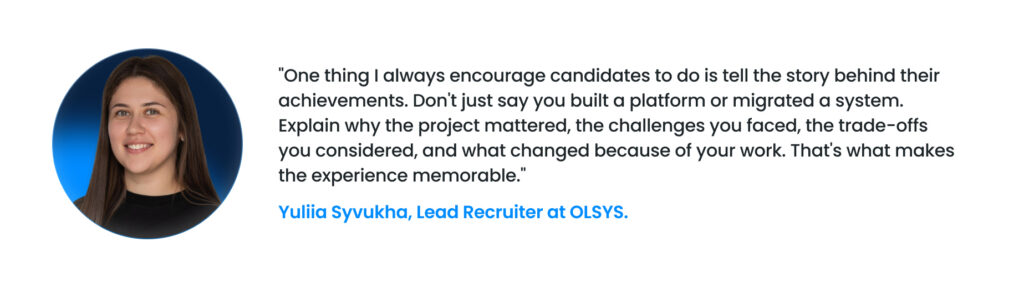
At OLSYS, we believe seniority is about much more than years of experience. It’s about ownership, technical judgment, continuous learning, and the ability to create lasting value for both clients and teammates.
Common Mistakes Senior Engineers Make
Even experienced candidates sometimes reduce their chances by:
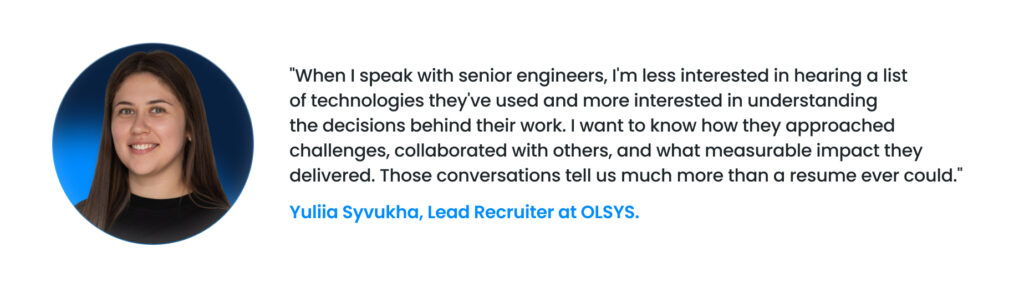
- Listing technologies instead of achievements
- Speaking only about implementation instead of decision-making
- Failing to quantify business impact
- Underestimating the importance of communication
- Appearing resistant to feedback or new technologies
- Focusing entirely on coding while overlooking leadership and collaboration
Recruiters understand that senior engineering roles require much more than writing excellent code.
The Future of Senior Engineering Hiring
Hiring expectations continue to evolve.
As AI automates more routine development tasks, companies are placing even greater value on the qualities that are uniquely human: architectural thinking, engineering judgment, communication, collaboration, mentorship, and the ability to connect technology with business outcomes.
The engineers who will stand out are those who combine deep technical expertise with curiosity, ownership, and a proven ability to make both products and teams stronger.
Final Thoughts
Being a senior engineer today is no longer defined solely by technical expertise or years of experience.
Recruiters are looking for professionals who create measurable impact, communicate effectively, lead through influence, and consistently make thoughtful technical decisions that benefit both the product and the business.
At OLSYS, we believe the best engineers never stop learning, enjoy solving meaningful challenges, and understand that great software is built through collaboration.
If that sounds like you, we’d love to meet you. Explore our open opportunities and discover how you can help build innovative products alongside talented engineering teams at OLSYS.