

Beyond the Role: What Ownership Mindset Actually Means in Tech

Mention the word “ownership” in an engineering team chat, and watch the skepticism roll in. To most developers, it sounds like a polished corporate term for “do two people’s jobs and put out fires on Saturday.”
But when done right, an ownership mindset isn’t a trap to make you work harder. It’s a cheat code for getting more autonomy, respect, and control over your work.
It is the transition from being a task executor who merely closes Jira tickets to an autonomous specialist who solves real product problems. Here is what an ownership mindset really looks like in practiceand why it is the ultimate catalyst for your professional growth.
What an Ownership Mindset Really Means (and What It Doesn’t)
In tech, an ownership mindset is the shift from asking “Did I finish my assigned task?” to asking “Did this feature actually solve the problem for the user and the business?”
What it is:
- Outcome-oriented: You care about the end-to-end impact on production, not just whether your pull request was merged into main.
- Systems thinking: You understand how your code, test coverage, or architecture decisions affect downstream services, team velocity, and business goals.
- Proactive accountability: If a release breaks something, you don’t waste time blaming DevOps or QA. You focus immediately on identifying the root cause and fixing it.
What it isn’t:
- ❌ Overworking and burnout: True owners build reliable systems, documentation, and automated processes so that emergencies rarely happen in the first place.
- ❌ Overstepping boundaries: It is not about overruling your Tech Lead, product managers, or ignoring established architecture patterns.
- ❌ Solo heroism: Trying to fix everything alone in isolation without keeping your team in the loop.
Why Should a Specialist Care? (What’s In It For You)
Developing an ownership mindset isn’t about giving the company free extra labor—it is a direct investment in your own career capital.
- More Autonomy, Less Micromanagement: When management and leads see that you take full responsibility for your domain, they step back. You get more freedom in tool selection, technical choices, and execution strategies.
- Accelerated Career Progression: The fundamental gap between a Strong Mid and a Senior/Lead specialist isn’t just knowing another framework. It is the level of autonomy and the ability to own complex systems from design to delivery.
- Protection Against Burnout: The most draining work comes from feeling like a disposable cog moving cards from left to right. Owning outcomes gives your day-to-day work tangible meaning and purpose.
Taking Responsibility Without Stepping on Others’ Roles
One of the biggest hazards when stepping up is overreaching—attempting to “own” something that belongs to a teammate or cross-functional partner (e.g., rewriting a peer’s module without asking or dictating product roadmaps to the PM).
To take initiative while respecting your team:
- Focus on handovers: Instead of trying to do QA or DevOps tasks yourself, ensure your deliverables come with thorough testing, clear deployment instructions, and context-rich documentation.
- Ask before acting: Frame your initiatives as collaborative proposals: “I noticed a potential bottleneck in our database queries. I came up with an optimization approach—can we review it together at the next tech sync?”
- Respect domain expertise: Bring facts and data to discussion tables, but respect the final decision of Product Managers on business priorities or Solution Architects on system design.
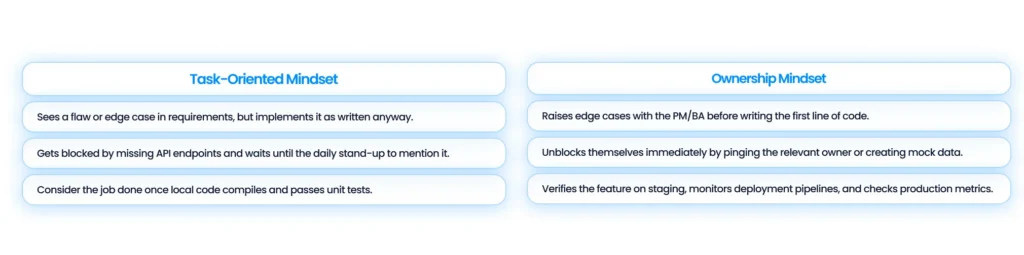
Proactive Behavior vs. Waiting for Instructions
In software engineering, the difference between a task executor and an owner is evident in daily work habits:
Following Through and Building Reliability
In distributed or remote teams, reliability is your most valuable currency.
- Own the full lifecycle: Your responsibility ends when the end-user can smoothly use the feature without friction.
- Flag risks early: If a delivery estimate is slipping due to unexpected technical complexity, communicate it early. Owning a project means managing risks openly, not hiding them until deadline day.
- Close the feedback loop: After release, ask your PM or analytics team: How is the new feature performing? Are there any unexpected user drop-offs or support tickets?
Speaking Up When Something Doesn’t Work
True owners treat company resources, codebase quality, and team time as if they were their own. When technical debt or broken processes slow everyone down, they don’t complain in silence—they speak up constructively.
- Advocate for technical debt with data: Complaining about legacy code in coffee chats changes nothing. Bringing a proposal to a Tech Debt session with data (e.g., “This module accounts for 40% of our regression bugs and delays releases by 2 days”) gets results.
- Bring solutions, not just complaints: Never enter a thread with just “This is broken.” Always bring a brief problem description accompanied by 1–2 potential paths forward.
- Disagree and commit: Debate fiercely during the design and planning phase. But once the team or leadership finalizes a decision, commit fully to executing it efficiently without sabotage.
Ownership as a Shared Team Culture, Not Individual Heroics
A culture reliant on “heroics” is a dangerous anti-pattern. Having one Senior Engineer who knows everything, fixes all outages alone, and keeps access restricted creates a Bus Factor of 1 and stunts everyone else’s growth.
Sustainable team ownership relies on:
- Knowledge sharing: Writing clear documentation, running internal tech talks, and onboarding junior team members.
- Psychological safety: Embracing blameless post-mortems so the team can learn from production failures without fear of blame.
- Shared accountability: Treating production outages not as a single developer’s fault, but as an opportunity for the team to strengthen CI/CD pipelines and automated testing.
Summary
An Ownership Mindset in tech isn’t about working harder—it’s about thinking broader. When you look beyond your immediate role, anticipate bottlenecks, and drive outcomes from start to finish, you naturally transform into a high-value specialist every engineering team wants to hire and retain.