


The Skills That Will Define Tech Careers in the AI Era
Artificial intelligence is reshaping software engineering faster than any technological inflection point in decades. AI-powered tools are no longer just experimental autocomplete plugins; they are actively changing how applications are structured, tested, and maintained.
This shift renders the old narrative—Will AI replace developers?—entirely obsolete. The real question confronting elite tech professionals is: When AI can generate hundreds of lines of code in seconds, where does a human engineer’s true value lie?
At OLSYS, we believe the answer isn’t less technical expertise; it’s higher-leverage expertise. The future of tech belongs to engineers who don’t compete with AI, but instead operate as its architect, director, and critic.
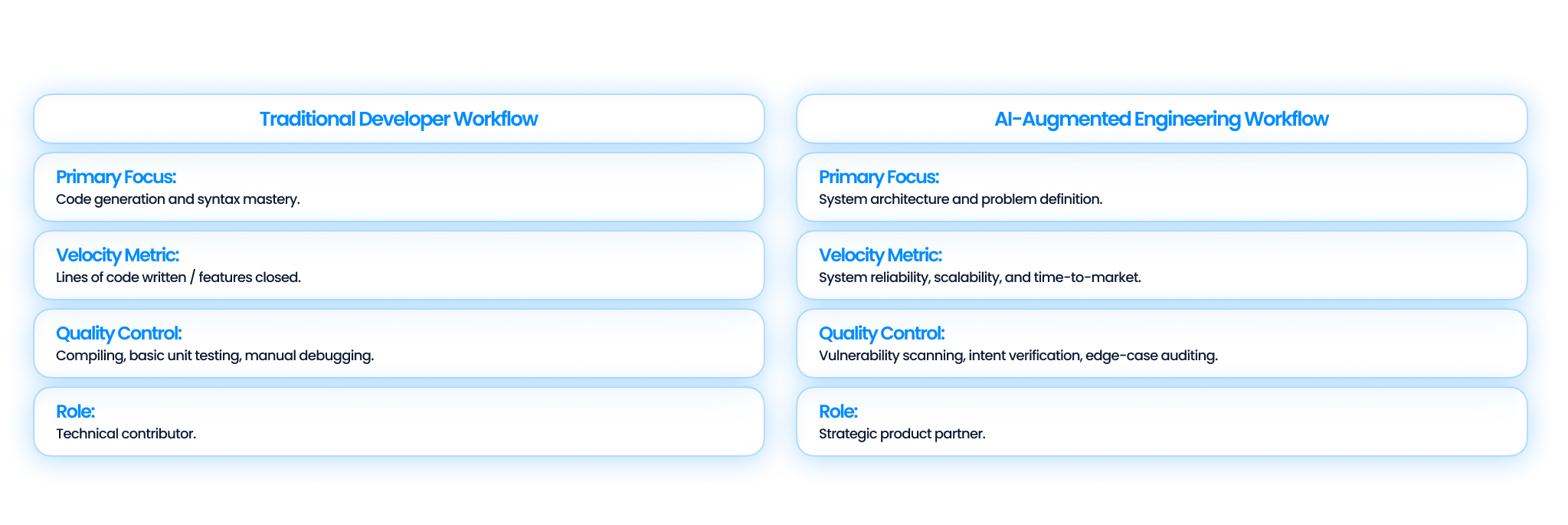
The Evolution of the Engineering Workflow
To stay competitive, developers must shift their daily focus from tactical execution (writing boilerplate, basic debugging) to strategic oversight.
The Four Pillars of the Future-Proof Engineer
To build a resilient career in this new ecosystem, software professionals must master four core disciplines that blend deep technical acumen with uniquely human capabilities.
1. Architectural Thinking and Autonomous Code Review
AI can generate code at scale, but it lacks situational awareness. It cannot predict how a microservice will interact with a legacy database under a sudden traffic spike, nor can it instinctively design for long-term maintainability.
The modern engineer must transition from a code writer to a highly critical code reviewer and system architect.
- Intent Verification: Evaluating AI outputs not just for “Does it work?” but “Is this the optimal pattern for our specific constraints?”
- Risk & Debt Mitigation: Identifying hidden security vulnerabilities, logical hallucinations, and subtle technical debt that AI frequently introduces.
- Systems Thinking: Focusing on how components integrate, scale, and fail gracefully.
2. Deep Business Context and Product Empathy
An AI model can write API endpoints seamlessly, but it has zero understanding of your customer’s pain points, your company’s business model, or market timing.
The most valuable engineers are those who bridge the gap between technical execution and business outcomes.
- Outcome over Output: Choosing architecture based on business velocity and user experience rather than purely technical perfection.
- Cross-Functional Translation: Acting as a trusted advisor to product managers and executives, translating complex technical trade-offs into clear business risks and opportunities.
3. Advanced AI Orchestration and Literacy
Treating AI as a static search engine is a competitive disadvantage. Elite engineers treat AI as an intern—one that is incredibly fast but requires precise direction, constant boundaries, and rigorous quality control.
- Deterministic Guardrails: Knowing exactly when to leverage AI for velocity (boilerplate, migrations, script writing) and when to shut it off to protect data privacy or handle hyper-complex logic manually.
- Validation Frameworks: Developing systematic workflows to verify, stress-test, and benchmark AI-generated infrastructure before it ever hits a staging environment.
4. High-Trust Collaboration and Ethical Judgment
Software is ultimately built by people, for people. As AI standardizes technical execution, the human dynamics of engineering—trust, alignment, and ethics—become the ultimate differentiators for engineering teams.
- Technical Leadership: Guiding cross-functional teams through ambiguity, mentoring junior developers navigating the AI landscape, and driving engineering culture.
- Ethical Governance: Asking the critical questions that algorithms cannot: Is customer data being handled transparently? Are we introducing systemic bias? Should this feature exist at all?
Final Thoughts: Navigating the Shift
Every major technological shift has redefined the skills that matter most. Cloud computing revolutionized infrastructure; Agile transformed delivery. AI is now redefining the very nature of human cognitive leverage in technology.
The software engineers who thrive in this next decade will not be those who write the most code, but those who create the most systemic value. By pairing rock-solid engineering fundamentals with rigorous critical thinking, business acumen, and strategic oversight, you won’t just future-proof your career—you will shape the direction of the industry.
At OLSYS, we are actively building this collaborative future. The tools have changed, but the mission remains the same: solving complex human problems through exceptional engineering.